



When Sarah and Miguel got engaged, they did everything right. They sat down, set a firm $25,000 budget, and made a plan: find the cheapest vendor for each item individually, negotiate hard, and DIY what they could.
Six months later, they were staring at quotes totaling $38,000.
Their story isn’t unusual. At Pelazzio, we host hundreds of weddings every year in Houston and we’ve watched this exact situation unfold more times than we can count. Couples start with solid intentions and a realistic budget, then watch it spiral — not because they’re careless, but because they’re acting on widely believed myths about how wedding costs actually work.
Here are the five most expensive wedding budget myths we see — and the reality behind each one.
TL;DR
- Myth 1: À la carte vendors are cheaper than all-inclusive packages.
- Myth 2: You can negotiate better deals by going directly to vendors.
- Myth 3: DIY will save significant money.
- Myth 4: The hidden costs aren’t that bad.
- Myth 5: Finding the cheapest option for each item produces the cheapest total.
- The reality: All five myths reliably lead to budget overruns. All-inclusive packages from established venues typically cost 25–35% less when every line item is properly accounted for.
Myth 1: “À La Carte Is Cheaper Than an All-Inclusive Package”
À la carte means picking and paying for each vendor separately — your own caterer, your own DJ, your own decorator, your own photographer. The logic is simple: why pay for a bundled package when you can buy only what you need?
The reality: Each vendor brings their own fees that don’t exist inside a package.
Your caterer charges a delivery and setup fee. Your decorator charges for transportation and strike time. Your photographer adds a travel fee to your venue. Your DJ charges for equipment load-in and breakdown. Your rental company charges a delivery fee for the tables, chairs, linens, and glassware that a full-service venue includes automatically.
By the time you’ve paid five or six separate setup and delivery fees, you’ve added costs that are invisible on any individual quote but very visible on your final total.
Then there are the rental costs almost everyone forgets until the deposit is due. Tables, chairs, linens, plates, glasses, silverware, serving dishes — in the Houston market, renting these separately typically runs $3,000 to $5,000 for a 100-guest event. All-inclusive Houston wedding venues include every one of these items in their per-person price.
What this actually costs: A couple planning a 100-person wedding through à la carte vendors typically pays $1,500–$3,000 more in fees and rentals alone compared to booking an all-inclusive venue at a comparable per-person price — before a single meal is served.
Myth 2: “I Can Negotiate Better Deals With Individual Vendors”
Some couples spend significant time negotiating with caterers, photographers, and DJs, believing that going direct gives them leverage. Sometimes they do get a small discount. But here’s what they’re negotiating against.
The reality: Established Houston venues have already out-negotiated you — by years.
Pelazzio hosts multiple events every week, every year. That volume gives us purchasing power that no individual couple can replicate. We’ve already negotiated bulk rates with our catering suppliers, our linen providers, our preferred vendors — and those negotiated rates are baked into our package pricing.
Here’s the math that makes this concrete: An individual couple might negotiate a caterer from $85/person down to $75/person and feel like they won. Meanwhile, an all-inclusive venue with 400+ events per year has negotiated the same caterer to $55/person because they guarantee steady volume. That $20/person difference on a 100-guest event is $2,000 — on catering alone. The same dynamic applies to florals, photography, entertainment, and décor.
The negotiating myth is understandable. It feels like taking control. But the venue with an established vendor network has already done the negotiating on your behalf, at a scale that individual couples simply cannot match.
Myth 3: “DIY Will Save Me Money”
Pinterest and Instagram have made DIY weddings look accessible — beautiful centerpieces, handmade favors, custom signage, homemade cake. For small personal touches, DIY can absolutely add something unique. For major elements of a wedding, the math almost never works out the way couples expect.
The reality: DIY almost always costs more than couples plan — in money and in stress.
Take centerpieces as a real example. A couple sees beautiful DIY flower arrangements online and estimates they’ll save $400 by making 15 arrangements themselves instead of paying a florist. Here’s what actually happens:
Flowers must be purchased in bulk, which requires minimum orders and often overnight shipping to ensure freshness. Vases, floral foam, wire, tape, and waterproof containers add up. You need a vehicle large enough to transport 15 finished arrangements safely. And you spend all or most of the day before your wedding — a day that should be for rest, beauty appointments, or time with family — making centerpieces in a garage.
When the actual costs are itemized — bulk flowers, supplies, transportation, and the hours lost — most couples find they’ve spent roughly the same as a professional florist would have charged. Except the florist’s arrangements looked better and nobody had to skip their rehearsal dinner prep to finish them.
The same pattern plays out with homemade cakes, DIY playlists instead of a DJ, and trying to coordinate vendors yourself. Professional services exist because they deliver value that’s genuinely hard to replicate at home — and attempting to replicate them often costs more than the professional version.
Myth 4: “The Hidden Costs Aren’t That Significant”
Couples who choose the à la carte route often acknowledge there will be some extra fees, but assume they’ll be manageable. They rarely are.
The reality: The hidden costs of vendor-by-vendor planning are some of the largest line items in a wedding budget — they just don’t appear until it’s too late to reverse course.
Day-of coordination is the biggest one. When you hire 10–12 separate vendors, someone needs to manage them all on the wedding day — confirming arrival times, directing setup, troubleshooting when the florist is late and the caterer has a question about table configuration. Most couples don’t realize they need a day-of coordinator until four to six weeks before the wedding. At that point, they’re scrambling to hire one for $1,500 to $3,000. All-inclusive venues provide a dedicated event coordinator as a standard part of their service — it’s not an add-on, it’s built in.
The time tax. Coordinating 10–15 separate vendors requires dozens of hours of calls, emails, contracts, follow-ups, and meetings over six to twelve months. Most couples dramatically underestimate this time commitment until they’re in the middle of it. The mental load has real value, even when it doesn’t show up as a line item.
Payment processing fees. Paying 12 different vendors separately means paying credit card processing or bank transfer fees 12 separate times. This rarely appears in a budget spreadsheet but consistently adds $300–$500 to the total cost of a wedding planned à la carte.
Myth 5: “Finding the Cheapest Option for Each Service Produces the Cheapest Total”
This is the myth that causes the most lasting damage — because it’s the one most likely to affect the wedding day itself, not just the budget.
The reality: Low-cost vendors frequently produce problems that can’t be fixed after the fact.
A budget photographer might miss key moments or deliver images you can’t use for your album. A low-cost caterer might run short on food or serve meals that don’t meet expectations. An inexperienced DJ might struggle with transitions or play music that doesn’t fit the room. These outcomes can’t be undone after the wedding, and many couples spend money afterward trying to supplement or replace what they received.
Low-cost raw venues also follow this pattern. A space that looks like a bargain at $2,000 often lacks essential infrastructure — adequate sound systems, proper lighting, temperature control for Houston summers, built-in parking. The base price is attractive. The final cost after adding all necessary rentals frequently exceeds what a properly equipped, full-service venue would have charged from the start.
Smart wedding budgeting isn’t about minimizing the cost of each individual item. It’s about understanding total cost — including fees, rentals, coordination, and the real likelihood of each vendor delivering what they promised.
What All-Inclusive Actually Covers
Because “all-inclusive” gets used loosely in the Houston wedding market, it’s worth being specific about what a genuine all-inclusive package should include:
Venue rental, tables, chairs, linens, basic décor, catering, beverages (including bar service), professional event staffing, setup, and cleanup. Those are the minimum. Premium packages add photography, DJ and emcee, upgraded décor and florals, and transportation.
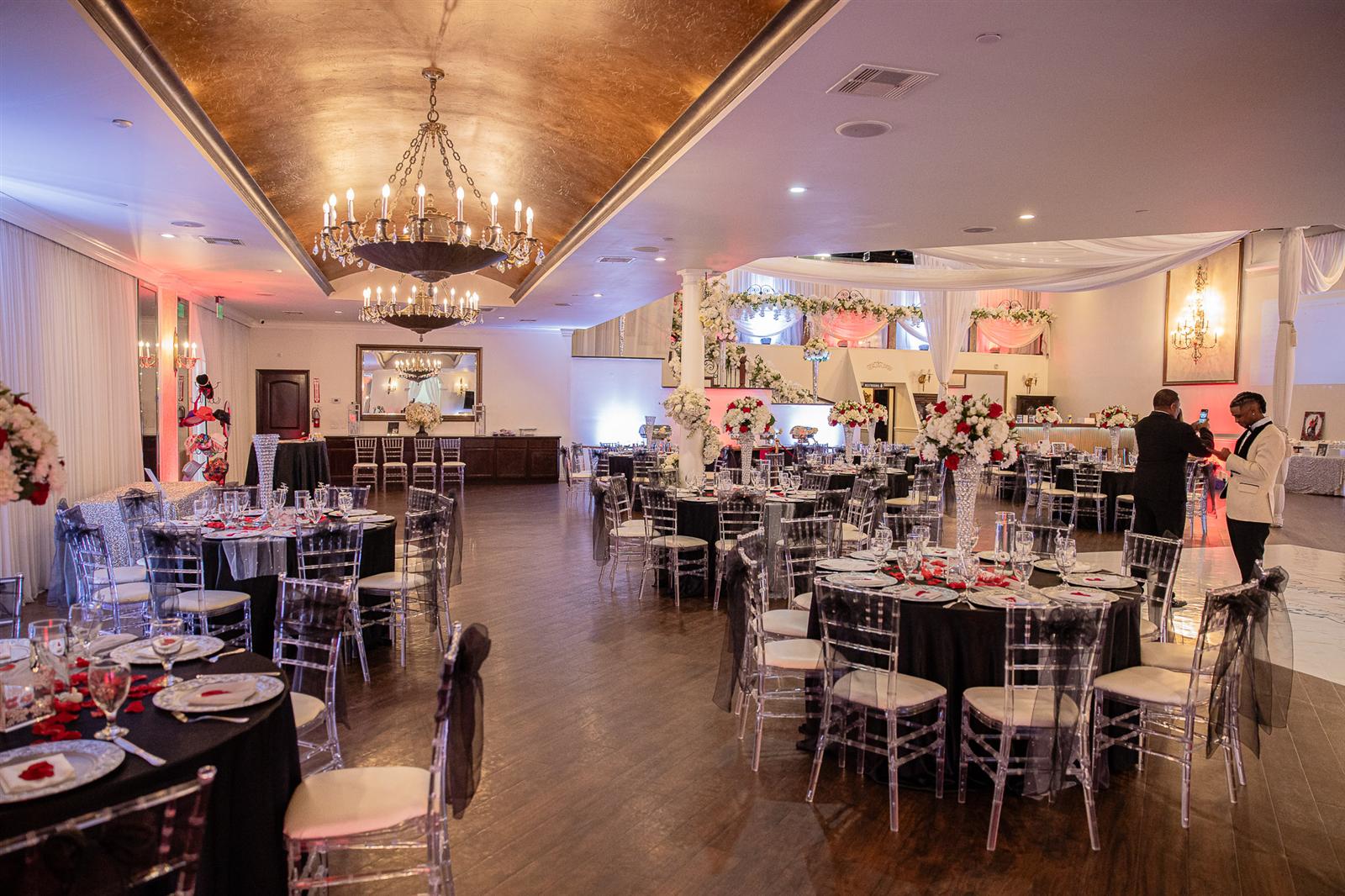
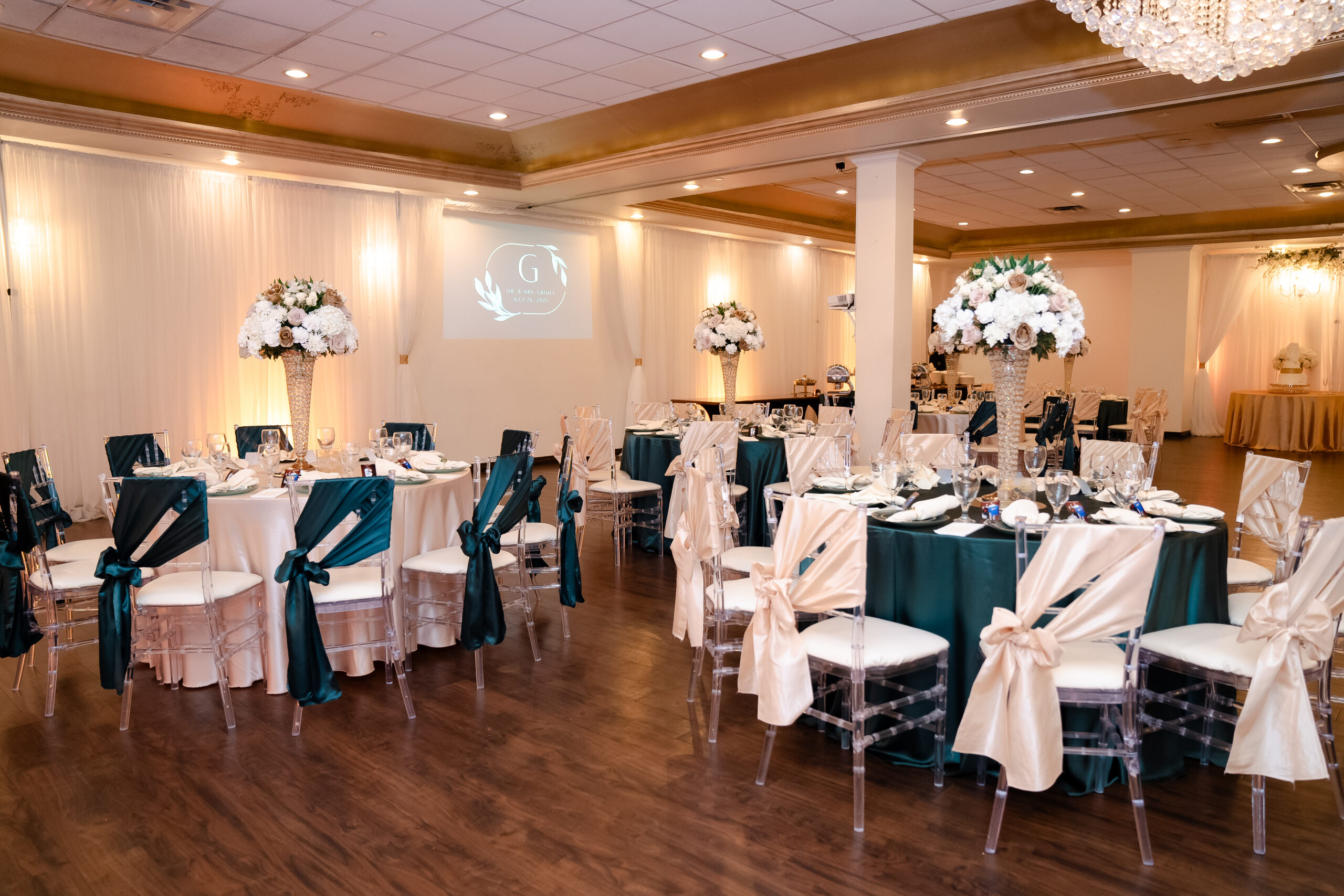
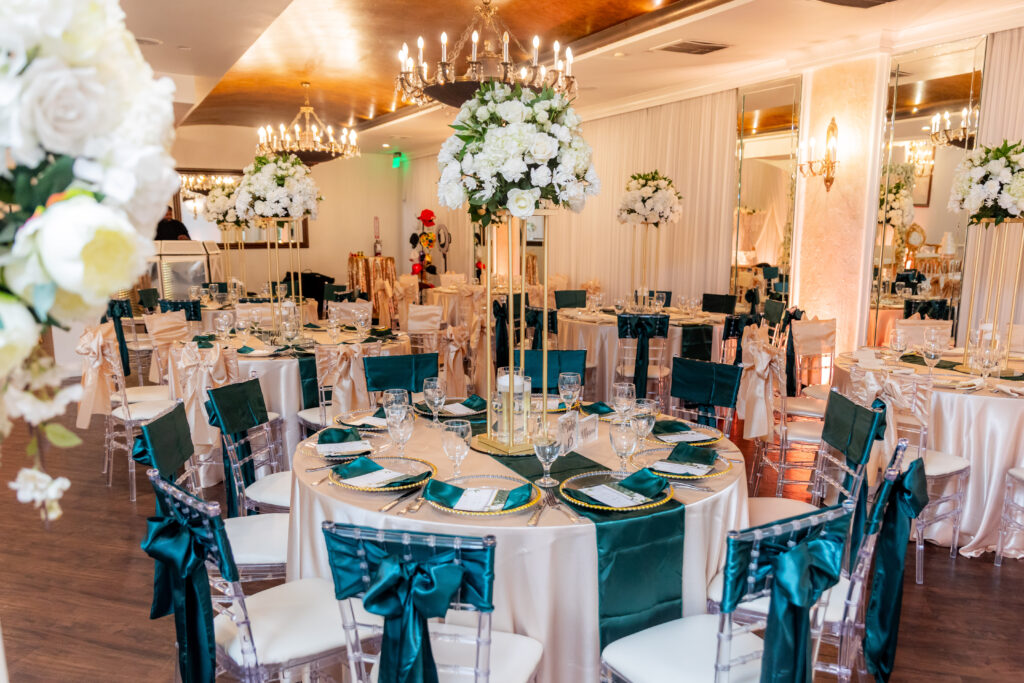
At Pelazzio, our Paradise Package at $109/person includes: gourmet in-house catering, a 4-hour premium open bar (beer, wine, and hard liquor), a custom buttercream cake, fresh flower centerpieces, professional photography (up to 8 hours), DJ and emcee, limousine service, upgraded linens and uplighting, full event staffing, and a dedicated Certified Event Specialist.
Couples who price each of those services out separately in the Houston market consistently find they’d spend $15,000–$20,000 more booking each vendor individually. The per-person price that looks higher on the surface is almost always lower in total.
Our Signature Package at $89/person covers catering, beer and wine bar, DJ, photography, and upgraded décor for a minimum of 75 guests. Our Rental Package at $45/person gives you the venue infrastructure — room, tables, linens, and staffing — while letting you bring your own vendors.
The Budget Framework That Actually Works
Here’s the approach we recommend to couples who want to avoid these myths:
List every item you need — not just the obvious ones. Most couples list catering, venue, and photography. They forget: tables, chairs, linens, plates, glasses, serving dishes, bar equipment, transportation, setup crew, cleanup crew, day-of coordinator, payment processing fees, gratuities, and vendor travel fees. All of these exist in à la carte planning.
Price the same event two ways. Build a spreadsheet with every item listed individually using Houston market rates. Then request an all-inclusive quote for the same guest count and compare the totals — not the per-person prices. This comparison almost always reveals that all-inclusive is the lower-cost option once every item is accounted for.
Factor in your time. If planning this wedding requires 100+ hours of vendor coordination over the next 12 months, that time has value. All-inclusive packages with a dedicated coordinator don’t just save money — they save the planning experience itself.
FAQ: Wedding Budget Questions
Is an all-inclusive wedding venue actually cheaper than booking vendors separately in Houston?
For most couples, yes — especially when all costs are accounted for. The per-person price of an all-inclusive package often looks higher at first glance, but it eliminates separate rental fees, delivery charges, day-of coordination costs, and payment processing fees that add $5,000–$10,000 to the true cost of a vendor-by-vendor approach. The honest comparison is total cost, not per-person rate.
What are the most commonly forgotten wedding costs?
The most frequently overlooked costs are day-of coordination ($1,500–$3,000 if hired separately), tables and chair rentals, linen rentals, glassware and tableware rentals, vendor delivery and setup fees, bartender service fees, gratuities for each individual vendor, and payment processing fees across multiple transactions. All-inclusive packages absorb most of these into a single per-person price.
At what point is DIY actually worth it for a wedding?
DIY makes genuine sense for small, personal touches that don’t require professional execution — handwritten place cards, a custom photo display, a family-recipe dessert table alongside a professional cake. DIY almost never makes financial sense for major event elements (centerpieces at scale, bar service, DJ, photography, catering) where the equipment, logistics, and professional skill involved make outside services more cost-effective than they appear.
How do I know if an all-inclusive package is actually all-inclusive?
Ask for a line-item list of everything included. A genuine all-inclusive package covers venue rental, tables, chairs, linens, catering, bar service, staffing, setup, and cleanup — at a minimum. Watch for packages that include the room but charge separately for tables, or include catering but charge separately for a bar setup. Transparency about what’s included and what isn’t is a reliable indicator of how a venue will handle the planning process overall.
The budget you start with doesn’t have to be the budget you end up with. But protecting it requires understanding where the myths are and planning around them from the beginning.
If you’d like to see exactly how Pelazzio’s package pricing compares to building the same event from scratch, schedule a free tour and we’ll walk you through the numbers side by side. Call us at 281-531-0008.